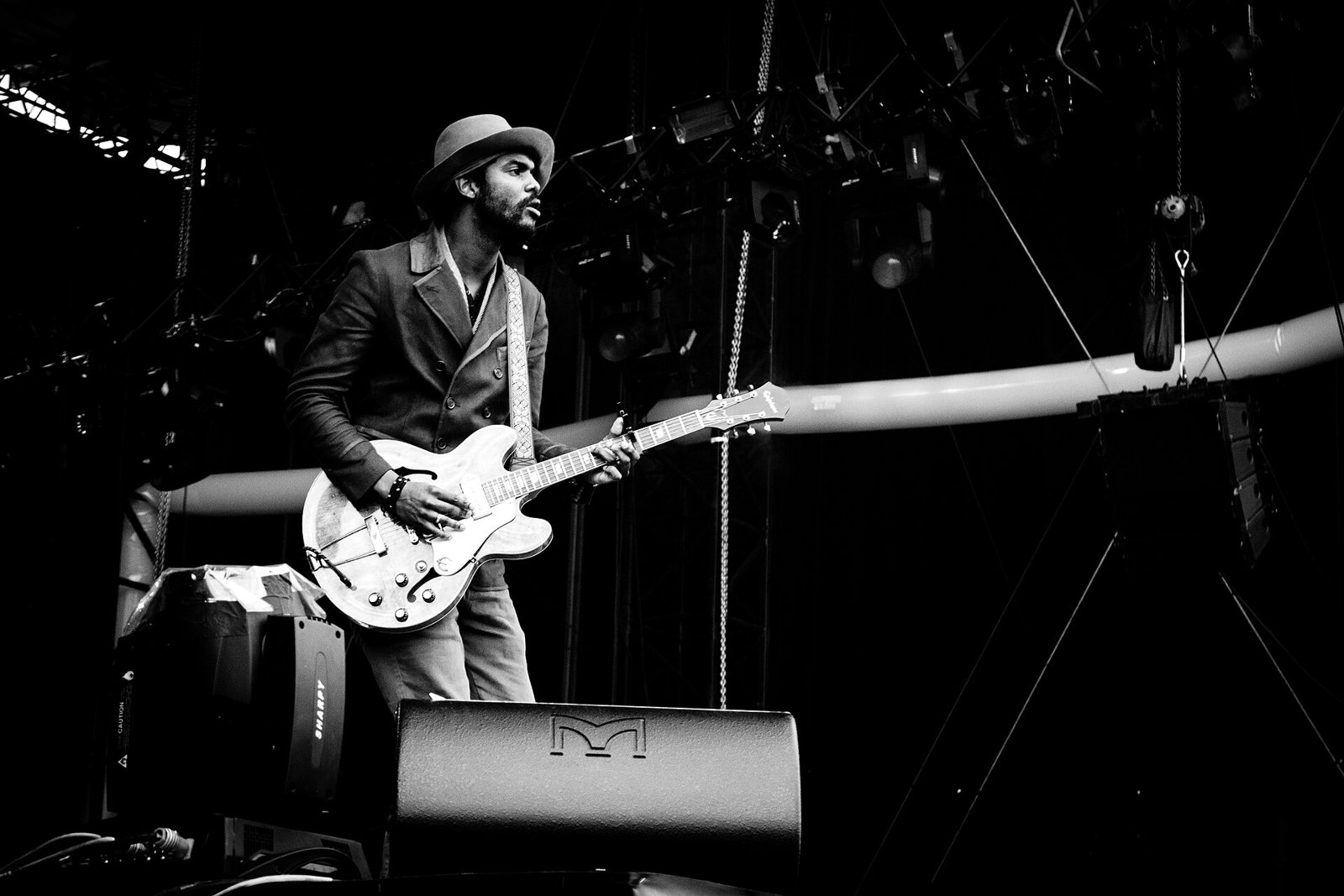
The blues has always had a thing for crossroads.
Robert Johnson had a road to choose.
Gary Clark Jr. has a train to catch.
The difference may seem small, but it spans almost a century of blues.
Clark grew up in Austin, close enough to the source to still breathe in its scent. By fifteen, he was already onstage at Antone's with men like Hubert Sumlin, Pinetop Perkins and James Cotton. He would later call that club his “foundation.”
Enough biography.
The guitar tells the rest.
When My Train Pulls In starts like a door slamming shut.
The riff doesn't walk. It rattles down the tracks.
Bass and drums lay the rails, and Clark rides over them with a guitar that sounds like it's got sand in the gears. The tone is huge, grainy, saturated. It doesn't have the polished shine of blues behind glass.
It's got rust under its fingernails.
And this is where the setup matters.
Clark made the Epiphone Casino one of his essential instruments. He has spoken about his love for its P-90s, its light weight and fully hollow body, as well as his fascination with the big semi-hollow sounds of Otis Rush, Freddie King and B.B. King. Various rig reconstructions for Blak and Blu point to the Casino and Fender Vibro-King and Vibroverb amps, with the Vibro-King specifically associated with When My Train Pulls In.
One detailed reconstruction of the solo tone also links the recording to an Analog Man Astro Tone fuzz, King of Tone overdrive and Teese Real McCoy Custom Wah. It's a technical reconstruction, not an official session sheet, so it's best taken as a credible picture of the sound architecture rather than gospel truth.
And really, you only have to listen.
The fuzz doesn't dress the note.
It skins it alive.
The overdrive swells it; the wah changes the expression on its face. The Casino, hollow and high-strung, always sounds one breath away from rebelling against the amp.
It's a guitar kept on a short leash.
Clark bends strings like hot iron. His vibrato doesn't decorate: it shivers. Phrases start, break off, start again. Sometimes he leaves a note hanging there like a bare light bulb swinging in an empty station.
Then silence.
Clark knows exactly what to do with it.
Because in the blues, empty space can weigh more than twenty notes.
The unavoidable ghost is Jimi Hendrix. Relix described When My Train Pulls In as Hendrix-like rock-blues. But Clark doesn't seem interested in digging Hendrix up again.
He does something more interesting.
He takes the vocabulary of the dead and speaks it with the accent of the living.
Fuzz, feedback, soul, rock, blues.
Iron, smoke and frequencies.
The blues stops being a black-and-white photograph and starts smelling like burning electricity again.
And this is where the train meets the crossroads.
Doyle Bramhall II introduces Clark to Eric Clapton. Clapton invites him to the 2010 Crossroads Guitar Festival, where his performance of Bright Lights helps throw open the door to a wider audience and the attention of Warner Bros. Records.
Crossroads.
The crossroads.
A coincidence almost too good to be true.
The old blues came to the crossroads to choose a road.
Clark arrives with a different problem:
What do you do with all that blues you've inherited?
Imitating it would be easy.
Preserving it would be respectful.
Clark would rather put it back on the rails.
That's why When My Train Pulls In feels like more than a song about wanting to leave. Its words speak of being stuck, bad news, frustration and the need to catch the next train and move on.
But the guitar is already telling the story of the journey.
It is locomotive and locomotion.
It roars, scrapes and rolls.
It accelerates. It brakes.
It blows fuzz out of the amplifier like smoke from a stack.
And Clark doesn't sound like a man patiently waiting at the station.
He sounds like someone who can already hear the train in the distance and has picked up his guitar and his suitcase.
Robert Johnson had the crossroads.
Gary Clark Jr. has the rails.
The blues is still the same journey. Only the means of travel has changed.


