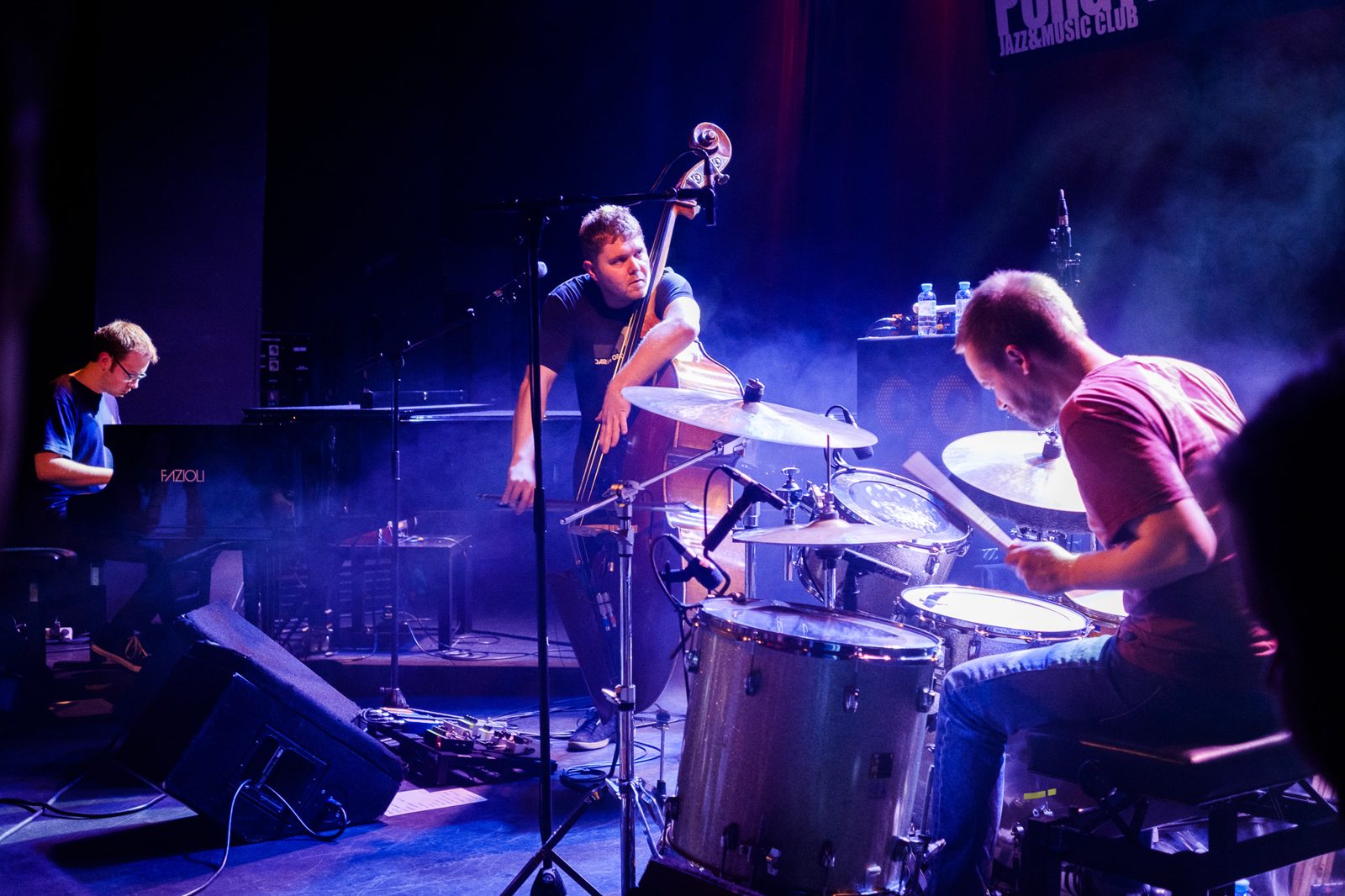
There is something immediately recognisable about GoGo Penguin: the cleanliness of their sound. Piano, double bass and drums occupy their own space with almost architectural precision. Nothing seems accidental, nothing is blurred for effect. Yet this clarity should not be mistaken for simplicity. Beneath the polished surface lies music of remarkable rhythmic and structural complexity.
The Manchester trio have spent more than a decade questioning what a contemporary jazz trio can be. Their vocabulary draws together jazz, classical minimalism and electronic culture, but the result increasingly resists those categories. Their own description of their music stresses precisely this meeting of jazz, classical and electronic influences, while their recent work has expanded the palette further through modular synthesizers, electric bass and a stronger electronic element.
What makes GoGo Penguin important, however, is not simply the combination of different genres. Plenty of musicians combine jazz and electronics. Their more significant achievement is rhythmic: they have helped reshape the language through which an acoustic jazz trio can think.
The drums frequently appear to follow the logic of programmed beats without surrendering the physical presence of a human drummer. The bass is not merely a harmonic foundation but part of the rhythmic machinery, while Chris Illingworth's piano often operates somewhere between melody, pulse and pattern. This produces music in which the instruments seem less like soloist and accompaniment and more like interlocking parts of a single organism.
And here lies one of the most misunderstood aspects of their music: minimalism.
With GoGo Penguin, minimalism is not simply repetition. It is an advanced minimalism, one in which an apparently simple musical cell is continually altered by rhythm, dynamics, articulation, displacement and interaction. Rather than hearing a phrase repeat unchanged, we hear it changing its meaning because everything around it is moving.
This is minimalism after electronic music, after contemporary jazz, after decades of rhythmic experimentation. It retains the hypnotic quality of repetition while refusing to remain comfortably inside the repetitive structures we have grown accustomed to.
Murmuration: Movement Inside Repetition
Few pieces reveal this idea better than Murmuration, from the 2014 album v2.0. The original recording features Chris Illingworth on piano, Nick Blacka on double bass and original drummer Rob Turner; it was released by Gondwana Records on March 17, 2014.
The title itself offers a useful metaphor for the music. Listen to Murmuration and the fascination comes not from a conventional jazz narrative of theme, solos and return, but from movement within the structure.
The piano establishes an idea that initially feels almost transparent. Then perception begins to shift. Bass, drums and piano continuously alter the weight and direction of the music. A pattern may remain recognisable, yet its relationship to the pulse changes. What sounded stable suddenly feels suspended; what seemed repetitive begins to reveal internal motion.
This is where the cleanliness of GoGo Penguin's sound becomes essential rather than merely aesthetic. Every rhythmic detail needs to be heard. Space becomes part of the composition. Precision creates tension.
Murmuration also points toward something that became central to the trio's identity: an acoustic ensemble capable of generating the sensation and propulsion associated with electronic music without sacrificing touch, dynamics and human interaction. The result is neither conventional jazz nor an acoustic imitation of electronica. It occupies the territory between them.
That approach was already significant during the v2.0 period. The album was subsequently shortlisted for the 2014 Mercury Prize, bringing international attention to the trio's distinctive approach.
Beyond the Formula
More than a decade later, the interesting thing is that GoGo Penguin have not simply continued reproducing that formula.
Their 2025 album Necessary Fictions, released on XXIM Records, pushes further into electronics, with modular synthesizers and electric bass taking a more substantial role in the group's sound. Contemporary reviews also singled out the continuing importance of their rhythmic language: Necessary Fictions was described as moving through arpeggiated piano figures, sharply defined drumming and fluid bass while retaining the band's cinematic character.
This evolution matters because it suggests that GoGo Penguin are not interested in defending a successful sound. They are interested in extending its grammar.
And perhaps that is the best way to understand them.
They have not reinvented jazz by abandoning its past. They have redesigned part of its contemporary vocabulary, bringing the logic of breakbeats, electronic production, minimalism and acoustic interplay into the same room. Their music can be immediately accessible, sometimes almost deceptively so, but beneath that surface everything is shifting.
Murmuration remains one of the clearest demonstrations of that idea: music that appears repetitive until you really listen, and then reveals that almost nothing is repeating in quite the same way.
That may ultimately be GoGo Penguin's most distinctive quality. Their sound is clean, but never sterile; minimalist, but never static; rhythmically precise, but unmistakably human.
They do not simply play jazz with a modern sound.
They make jazz think in a different rhythm.